
The Art of Long-Form Reddit Posts That Actually Get Read
This guide helps you understand the art of long-form Reddit posts that actually get read and decide what to do next without wasting posts, links, or account trust. Start by matching your goal to subreddit rules, reader intent, and account risk, then choose the safest next action.
Primary source check: review Reddit Rules, Reddit User Agreement, and Reddit for Business before using this advice in a live campaign.
Reddit loves short, punchy content. Scroll, upvote, move on.
But some of the most successful Reddit posts are long-really long. Detailed guides, complete breakdowns, epic stories.
These posts get saved, shared, and referenced for years.
The difference between a long post that dominates and one that gets ignored comes down to structure, formatting, and knowing when length serves the reader.
TL;DR - Writing Long Reddit Posts That Get Read

- Only go long when the topic genuinely requires depth - educational guides, case studies, original research, and resource compilations work best
- Structure posts with a strong hook in the first 2-3 sentences, a table of contents, clear headers, and a TL;DR summary
- Format ruthlessly with bold text, bullet lists, short paragraphs, and white space so readers can scan before committing to read
- Front-load value in every section so readers who stop early still walk away with something useful
- Split posts over 3,000-4,000 words into a series to avoid losing readers to sheer length
Reddit SEO Decision Table
Decision | Use This When | Risk To Check |
|---|---|---|
Search intent | Threads answer a real research question | The content only promotes a brand |
Source quality | Comments include firsthand detail | Claims lack proof or context |
Link placement | The link supports the answer | The link appears before trust is built |
Longevity | The thread can rank for months | The topic expires quickly |
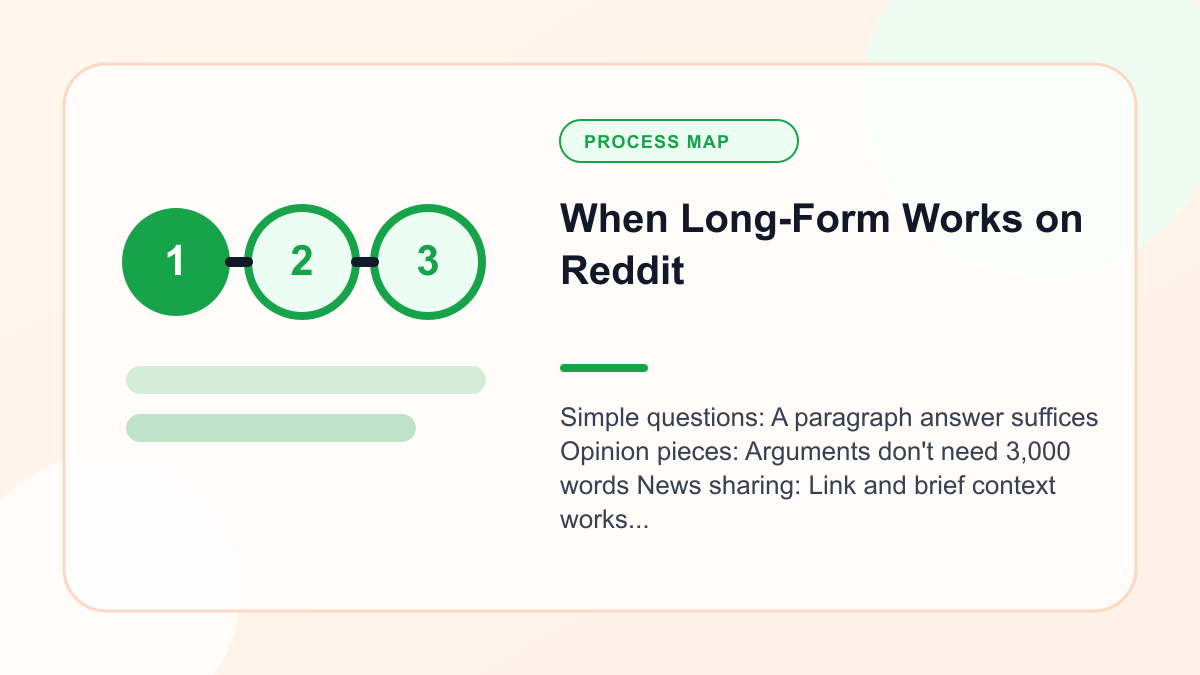
When Long-Form Works on Reddit
The Right Contexts
Long posts succeed in specific situations:
Educational content:
- Detailed how-to guides
- complete tutorials
- In-depth explanations of complex topics
Story-driven content:
- Personal experiences with narrative arc
- Case studies with setup, struggle, resolution
- "Here's what happened" breakdowns
Resource compilations:
- Complete lists with explanations
- Buying guides with comparisons
- Reference material people will save
Original research:
- Data analysis with methodology
- Survey results with interpretation
- Experiments with documented findings
The Wrong Contexts
Long posts fail when:
Simple questions: A paragraph answer suffices
Opinion pieces: Arguments don't need 3,000 words
News sharing: Link and brief context works better
Quick tips: Brevity is the point
The Decision Framework
Ask yourself:
- Does this topic *require* depth to be useful?
- Will readers *benefit* from complete coverage?
- Is there enough *substance* to justify the length?
- Would a shorter version actually be *worse*?
If yes to all four, go long. Otherwise, trim ruthlessly.
The Psychology of Long-Form Reading
Why People Abandon Long Posts
Wall of text: Unbroken paragraphs trigger "too much effort" response
No clear value: Reader can't tell if it's worth their time
Poor hook: Opening doesn't promise anything compelling
No navigation: Can't find the parts relevant to them
Buried payoff: Good content hidden behind lengthy preambles
Why People Finish Long Posts
Clear structure: They can see the journey
Early value: Something useful in the first few paragraphs
Scannable format: Can browse before committing
Momentum: Each section pulls them to the next
Payoff throughout: Value distributed, not just at the end
Structuring Long Posts
The Opening (Critical)
Your first 2-3 sentences determine everything:
Bad opening:
"I've been thinking about this topic for a while and wanted to share my thoughts. There's a lot to cover, so bear with me."
Good opening:
"After 3 years of testing, I've identified the 7 factors that determine whether a Reddit post succeeds or fails. Here's everything I learned."
The good opening:
- Establishes credibility (3 years of testing)
- Promises specific value (7 factors)
- Creates curiosity (what are they?)
For more on hooks, see our guide on Reddit post titles that drive clicks.
The Table of Contents
For posts over 1,000 words, include a TOC:
```
In this guide:
- Why most long posts fail
- The structure that works
- Formatting for scannability
- Examples from top posts
- Common mistakes to avoid
```
This lets readers:
- Assess if content is relevant
- Jump to sections they need
- See the scope before committing
Section Structure
Each section should follow this pattern:
Section header (clear, specific)
↓
Opening statement (main point in 1-2 sentences)
↓
Supporting content (details, examples, evidence)
↓
Transition (connects to next section)
The BLUF Principle
Bottom Line Up Front-put conclusions before explanations:
Bad structure:
"Let me explain the history, then the theory, then the evidence, and finally what you should do."
Good structure:
"Here's what you should do. Now let me explain why."
Readers get value immediately. Those who want depth continue reading.
Formatting for Scannability
Formatting is the difference between posts people read and posts people skip.
Essential Formatting Elements
Headers (##, ###):
- Break content into digestible sections
- Allow scanning before reading
- Create visual hierarchy
Bold text:
- Highlight key points
- Create anchor points for skimmers
- Emphasize important terms
Bulleted/numbered lists:
- Present multiple items cleanly
- Easier to process than prose
- Enable quick scanning
Short paragraphs:
- 2-4 sentences maximum
- White space is your friend
- One idea per paragraph
For complete formatting guidance, see our Reddit formatting guide.
The Scan Test
Before posting, ask:
- Can someone get the main points by scanning headers and bold text?
- Is there enough white space to feel readable?
- Are lists used where appropriate?
- Can readers jump to relevant sections?
If no, reformat.
Visual Breaks
Long posts need visual breathing room:
- Horizontal rules between major sections
- Images or diagrams where helpful
- Tables for comparative data
- Code blocks for technical content
Writing Techniques for Long Posts
Maintaining Momentum
Keep readers moving forward:
End sections with hooks:
"That covers the basics. But here's where it gets interesting..."
Use numbered sequences:
"The first factor is X. The second is even more important."
Create micro-cliffhangers:
"Most people stop here. The next section is why 90% of attempts fail."
Distributed Value
Don't save all the good stuff for the end:
Every section should provide value:
- A useful tip
- An interesting insight
- A practical takeaway
Front-load each section:
- Best content in the first paragraph
- Supporting details follow
- Readers who stop early still got something
Conversational Tone
Long posts need human voice:
Too formal:
"It is recommended that individuals consider the following factors when evaluating their options."
Better:
"Here's what you actually need to think about."
Write like you're explaining to a smart friend, not presenting to a committee.
The Rule of Three
When listing or explaining:
- Three examples is often enough
- Three steps feel manageable
- Three reasons provide sufficient support
More than three? Use categories or subgroups.
The TL;DR Strategy
Why You Need One
TL;DR (Too Long; Didn't Read) summaries:
- Respect readers' time
- Capture those who won't read fully
- Often get upvoted themselves
- Demonstrate your content has substance
Where to Place It
Option 1: At the top
- Readers know what they're getting
- May reduce full reads
- Best for utility content
Option 2: At the bottom
- Traditional placement
- Rewards full readers
- Works for story-driven content
Option 3: Both
- Brief preview at top
- Full summary at bottom
- Best of both worlds
How to Write a Good TL;DR
Bad TL;DR:
"TL;DR: Read the post."
Also bad:
"TL;DR: Lots of good tips about Reddit in here."
Good TL;DR:
"TL;DR: Long posts succeed when they have (1) clear structure with headers, (2) value in every section, (3) scannable formatting, and (4) a strong opening hook. Format for skimmers, write for readers."
A good TL;DR:
- Captures the actual main points
- Is useful on its own
- Makes people want to read the full version
Examples of Successful Long Posts
The Ultimate Guide Format
Structure:
```
Title: "The Complete Guide to [Topic]"
Opening hook + credibility
Table of contents
Section 1: Fundamentals
Section 2: Intermediate concepts
Section 3: Advanced strategies
Section 4: Common mistakes
Section 5: Resources
TL;DR
```
Works because: complete, organized, saves readers research time.
The Personal Story Format
Structure:
```
Title: "How I [Achieved Result]-Lessons Learned"
Opening hook (the result)
Background (brief context)
The journey (what happened)
Key turning points (the interesting parts)
Lessons learned (the transferable value)
Conclusion
```
Works because: Stories engage emotionally while providing actionable insights.
For storytelling techniques, see our guide on the art of the Reddit story post.
The Data/Research Format
Structure:
```
Title: "I Analyzed [X] and Here's What I Found"
Key findings (BLUF)
Methodology (how you did it)
Detailed results (the data)
Analysis (what it means)
Limitations (intellectual honesty)
Conclusions (actionable takeaways)
Raw data (for the curious)
```
Works because: Original research is rare and useful.
Common Long-Post Mistakes
Mistake 1: Burying the Lead
Spending 500 words on background before getting to the point.
Fix: Start with the payoff, explain background after if needed.
Mistake 2: Padding for Length
Adding words to seem complete.
Signs of padding:
- Restating the same point multiple ways
- Including tangentially related content
- Excessive caveats and qualifications
Fix: Every sentence should earn its place. Cut mercilessly.
Mistake 3: No Formatting
Posting a wall of text and expecting people to read it.
Fix: Headers, lists, bold text, short paragraphs. Always.
Mistake 4: Weak Sections
Some sections substantially weaker than others.
Fix: Either strengthen weak sections or cut them entirely. Inconsistent quality hurts overall perception.
Mistake 5: Missing the Audience
Writing at the wrong level-too basic or too advanced.
Fix: Define your reader before writing. Write for their level often.
Mistake 6: No Clear Takeaways
Reader finishes and thinks "so what?"
Fix: End with concrete next steps or clear conclusions.
When to Split Into Multiple Posts
Signs You Should Split
- Post exceeds 3,000-4,000 words
- Multiple distinct subtopics exist
- Sections could stand alone
- Different sections serve different audiences
How to Split Effectively
Create a series:
- Part 1: Fundamentals
- Part 2: Advanced Strategies
- Part 3: Real-World Applications
Link between parts:
- End each with preview of next
- Reference previous parts for context
- Create a hub post linking all parts
Timing:
- Space posts 1-3 days apart
- Build anticipation
- Allow discussion on each before moving on
Promoting Long Posts
Timing Matters More
Long posts need more time to gain traction:
- Post when your audience is most active
- Avoid competing with major events
- Allow time for reading and sharing
See our guide on best times to post on Reddit.
Engage in Comments
Long posts generate questions:
- Monitor comments closely
- Answer questions thoroughly
- Add clarifications via edits when needed
- Thank people for engagement
For comment strategies, see Reddit comment formulas that work.
Cross-Posting Strategy
Good long-form content often fits multiple subreddits:
- Identify relevant communities
- Tailor titles to each audience
- Space out cross-posts
- Engage in each community separately
Conclusion
Long-form posts aren't for everyone or every topic. But when appropriate, they can become the most useful content you create on Reddit-saved, shared, and referenced long after short posts are forgotten.
The keys to success:
- Choose the right topics: Education, stories, research, resources
- Structure for scanning: Headers, TOC, clear sections
- Format ruthlessly: Lists, bold, short paragraphs
- Front-load value: Main points first, details after
- Include TL;DR: Respect readers' time
- Maintain momentum: Keep readers moving forward
Length isn't the goal-value is. A 2,000-word post that delivers complete value beats a 500-word post that leaves questions unanswered.
But a 500-word post that's complete beats a 2,000-word post that's padded.
Write long when long is right. Format always.
The readers will follow.
For more on creating content that resonates, explore our guides on viral post anatomy and getting 500+ upvotes.
Frequently Asked Questions
How long is too long for a Reddit post?▼
There's no fixed limit, but posts over 3,000-4,000 words often benefit from being split into a series. The key isn't word count—it's value density. Every section should provide clear value. If you're padding to reach length, you've gone too long.
Should I include a TL;DR in long posts?▼
Yes. TL;DR summaries respect readers' time, capture those who won't read fully, and demonstrate your content has substance. Place it at the top for utility content, at the bottom for stories, or both for maximum effectiveness.
How do I format a long Reddit post?▼
Use headers (## and ###) to create sections, bold text for key points, bulleted lists for multiple items, and short paragraphs (2-4 sentences). Include a table of contents for posts over 1,000 words. White space is your friend.
When should I write a long post instead of a short one?▼
Go long for educational guides, story-driven content, resource compilations, and original research. Stay short for simple questions, opinions, news sharing, and quick tips. Ask: does this topic require depth to be useful?
Why do most long Reddit posts fail?▼
Common failures include wall-of-text formatting, weak openings that don't hook readers, buried value with lengthy preambles, no clear structure or navigation, and padding with unnecessary content. Structure and formatting are as important as content.
How do I keep readers engaged in a long post?▼
Distribute value throughout (useful tips in every section), maintain momentum with hooks between sections, front-load each section with main points, use conversational tone, and include visual breaks. Readers should get value even if they stop early.

Neo Anderson
Author
Reddit strategist and founder of Upvote.sh. I help brands cut through the noise on Reddit with data-driven upvote strategies that actually move the needle. When I'm not reverse-engineering the front page algorithm, I'm probably lurking in niche subreddits looking for the next big opportunity.